
The ash cloud seemed to be somewhat reduced this morning.
Both Profesora Ana and Profesora Maria use the phrase “poco a poco” (little by little) at the moments when Jill and I are not sure we are actually making incremental progress in our endeavor to learn Spanish. I heard “poco a poco” multiple times today from Profesora Maria.
We continue to focus on past-tense in our classes. Today’s exercise was to take a scene depicted on a laminated card and make up a story in past tense about what was going on in the scene. Each laminated card has vocabulary words listed on it and before we make up the story we go through the vocabulary words to make sure we know what they mean. Profesora Maria does not speak English to us, which makes for some interesting pantomime when we get to a vocabulary word neither of us can recall.
After we finished the vocabulary we set out on making up our stories. Jill killed it. I really struggle at this exercise. For the second time in as many tries I can’t seem to get the hang of it. I can conjugate the verb in past-tense, but struggle mightily with predicates and connectors like “por eso” (because) and “sin embargo” (nevertheless) and also with the various prepositions such as “a,” “de,” “en,” and “con.” For example, when trying to form the sentence “The children played on the slide in the park.” I get as far as “Los ninos jugaron” (The children played) and then get stuck on prepositions. In reality, it’s actually simpler in Spanish than English because “en” in Spanish is both “in” and “on” in English, but my brain currently locks up at that point. Poco a poco.
Jill made an observation today that totally rings true for me. As we are trying to figure out how to say things in Spanish, we are both involuntarily simplifying the sentence structure of our own internal monologue, trying to dumb it down to sentences we can say in Spanish. And that, in turn, makes us feel a little more infantile on the whole.
For the next two weeks on Tuesdays and Thursdays, we will have Profesora Maria for the first two hours of our lesson and then Profesora Ana will take over for the last hour. Today when we transitioned to Profesora Ana, we put away the libros (books) and just talked. I am pleased to report that we had a full hour of stimulating conversation in Spanish where we discussed a broad range of intriguing topics.
We learned that Profesora Ana retired from a career working for Copa Airlines (the national airline of Panama). She loves Costa Rica, but thinks Panama has the brightest future in Central America, largely because the revenue from the canals and ship flagging is a major and predictable source of income for the government. Her position is that since the Panamanian government has a commerce driven revenue stream with a clear accounting trail, there is less opportunity for the kind of graft and corruption that plagues other Central American countries. She also pointed out that Panama is a free trade zone where Costa Rica relies on import duties of up to 75% that crimp demand and put modern conveniences out of reach of people of modest means.
Side note: The impact of Costa Rica’s import duties is real and visible. Because our house doesn’t have a microwave, Jill and I looked at counter-top microwave ovens at PriceSmart and the starting price is $200, compared to $65 at your local Target in the US. We decided to pass. A decent used car in Costa Rica is 2x what it costs in the US.
We also learned that family farms in Costa Rica are suffering from a labor shortage because farming families have been successful getting the younger generation to take education seriously and the adult children are heading off in search of jobs that a university education has opened up to them. To fill the farm labor needs in Costa Rica farmers rely on migrant Nicaraguan laborers who send money back to their families in Nicaragua.
We also touched on the economic situation in Costa Rica and Profesora Ana is gravely concerned about the shrinking middle class in Costa Rica. I’ll have to fact check this, but according to Profesora Ana poverty rates in Costa Rica have doubled from 15% to 30% and continue climbing, increasing the need for social assistance programs and eroding the tax base of the country.
It was thoroughly gratifying to hear and be able to understand Profesora Ana’s well-reasoned arguments and opinions and to be able to compare and contrast our personal experience in our home country, all in Spanish. Poco a poco!
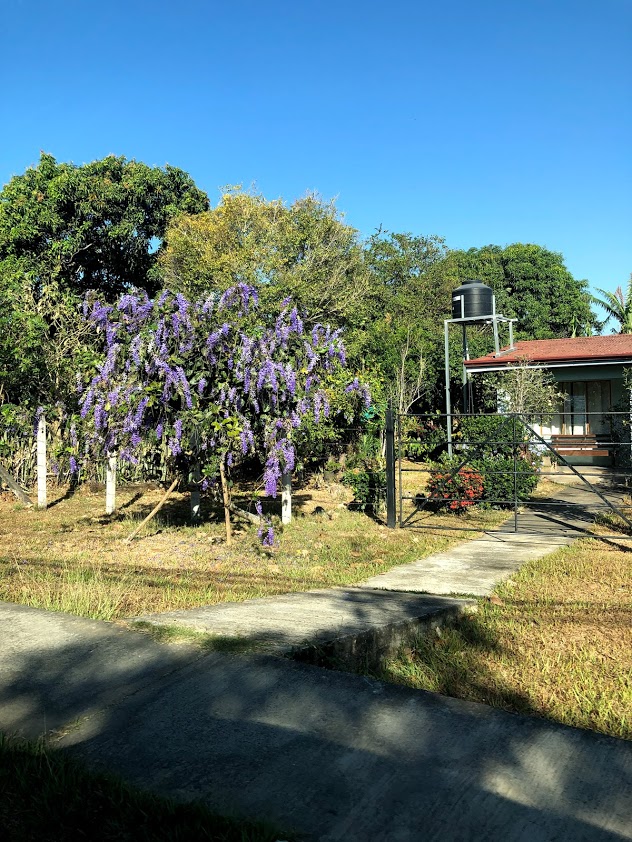
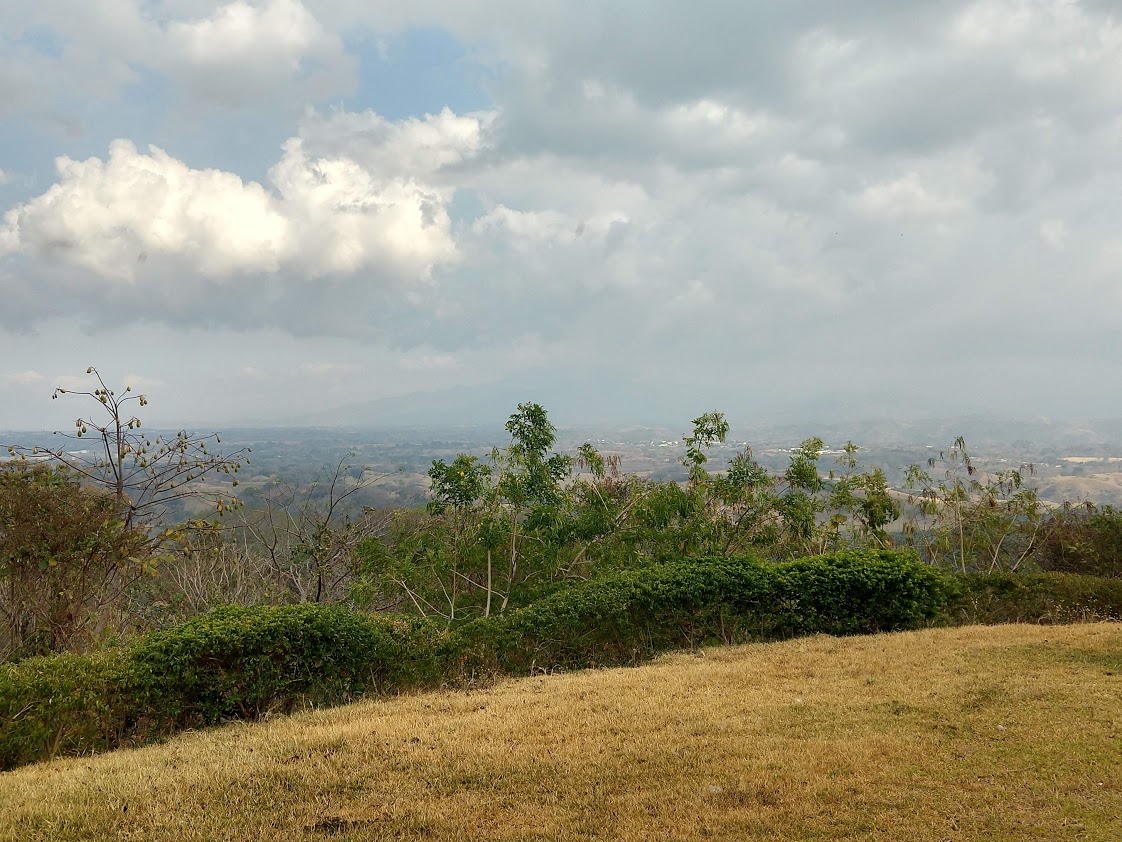
As the day wears on the ash haze is re-asserting itself. I wonder if it causes some sort of inversion layer around San Jose and the traffic exhaust accumulates during the day?
Well, that’s the news from Lake Wobegon for today.
 Jill and Todd in Costa Rica